
You kill an enemy, you take its move, and you use that move on the next one. That’s the whole idea behind False Hero, and honestly, few soulslikes have pushed it this far. The game wears its debt to the first Demon’s Souls and Dark Souls openly, in its narrow corridors and in the shortcuts that crack open at exactly the right moment. I came away with a combat system I haven’t met anywhere else, a mood that holds all the way through, and a progression system that genuinely annoyed me.
At a glance
A legendary mask lets you steal the combat abilities of fallen enemies and fold them into your own kit.
Combos that mix standard attacks with stolen abilities carry the entire combat system.
Upgrades depend on scarce physical materials, which makes farming pointless after a defeat.
What the mask in False Hero does to a fight
A mysterious figure gets hold of a legendary mask, and that mask lets them take the combat abilities of whatever they cut down. The Steam page, published by Ytopia for developer Torchlight Games, leads on exactly that. Every enemy becomes a walking catalogue, and the urge to beat a new one comes as much from curiosity as from need.
That idea stands in for the sprawling weapon list the genre usually hands you. A classic Souls game lets you hoard swords and axes; here, the variety comes out of abilities torn off creatures. Each one has its own effects, its own reach and its own best use, and you end up thinking in terms of a moveset rather than a loadout.
It fits the fiction nicely too. A force called Death is slowly rotting the Kingdom of Wisdom, and taking from the corrupted the very thing that makes them dangerous sits naturally in that setting. The storytelling stays deliberately open, leaving plenty of room for your own reading. The stealing mechanic carries the whole game, and it hands False Hero an identity that the crowd of recent soulslikes never quite found.

Chaining stolen abilities, where it gets brilliant
The game wants you switching between standard attacks and the abilities you’ve taken, and that’s where everything happens. Some combinations do more damage than the sum of their parts, others exist mainly to force an opening. I spent a serious amount of time working out which ones landed on which kind of opponent, and that tinkering is exactly what I want from a combat system.
Fights lean heavily on stuns, staggers and knockdowns. Against a boss, chaining properly builds sequences that feel genuinely great when you’re reading the fight right. The catch is that it cuts both ways. Certain enemies chain staggers of their own and pin you into sequences you can’t break out of.
Confined spaces are where it turns sour. Several attacks and projectiles arrive together, the camera shows you very little, and death lands before you’ve had a real chance to answer. Those enclosed fights are the only properly frustrating stretch of the game, and the rest of the time enemy placement struck me as demanding while staying fair.
Watch it too
False Hero is the indie darling everyone is talking about
Bosses that announce themselves first
Here’s something I appreciated: False Hero telegraphs its big moments. A boss gets flagged through visual, audio or environmental cues, and that care changes how exploration feels. You sense the difficulty spike coming instead of walking into it blind.
Level design follows the same school. Areas stay fairly linear, tight passages dominate, and the structure looks to the classic Souls games far more than to the openness of Elden Ring. Shortcuts that unlock after a successful push work exactly the way you’d hope. Enemies respawn, as the genre demands, and the environments keep their share of mystery. The enigmatic mood is the other real success here, and it holds across the run, which is rare in a game that bets this much on what it leaves unsaid.
Progression is the weak spot in False Hero
Forget the character sheet you’d normally level up in a Souls game. Resources you collect go mainly into improving the abilities taken from enemies, which makes sense in a game built around stealing moves. The trouble lies in how those improvements are gated.
Upgrading an ability calls for physical materials that exist in limited supply. Your power therefore tracks the route the game has planned for you, and your room to manoeuvre shrinks accordingly. A difficulty wall can no longer be solved with extra hours.
What bothered me most is the way respawns work. Enemies you’ve already killed stop yielding Wisdom when they come back, which strips any point from farming after a boss beats you. In a traditional Souls game, you absorb a defeat by going away and picking up a few levels; here you walk back in with precisely what you had before. It’s the choice I understand least, and the one that’ll send some players elsewhere.
A low-fi look that serves the strangeness
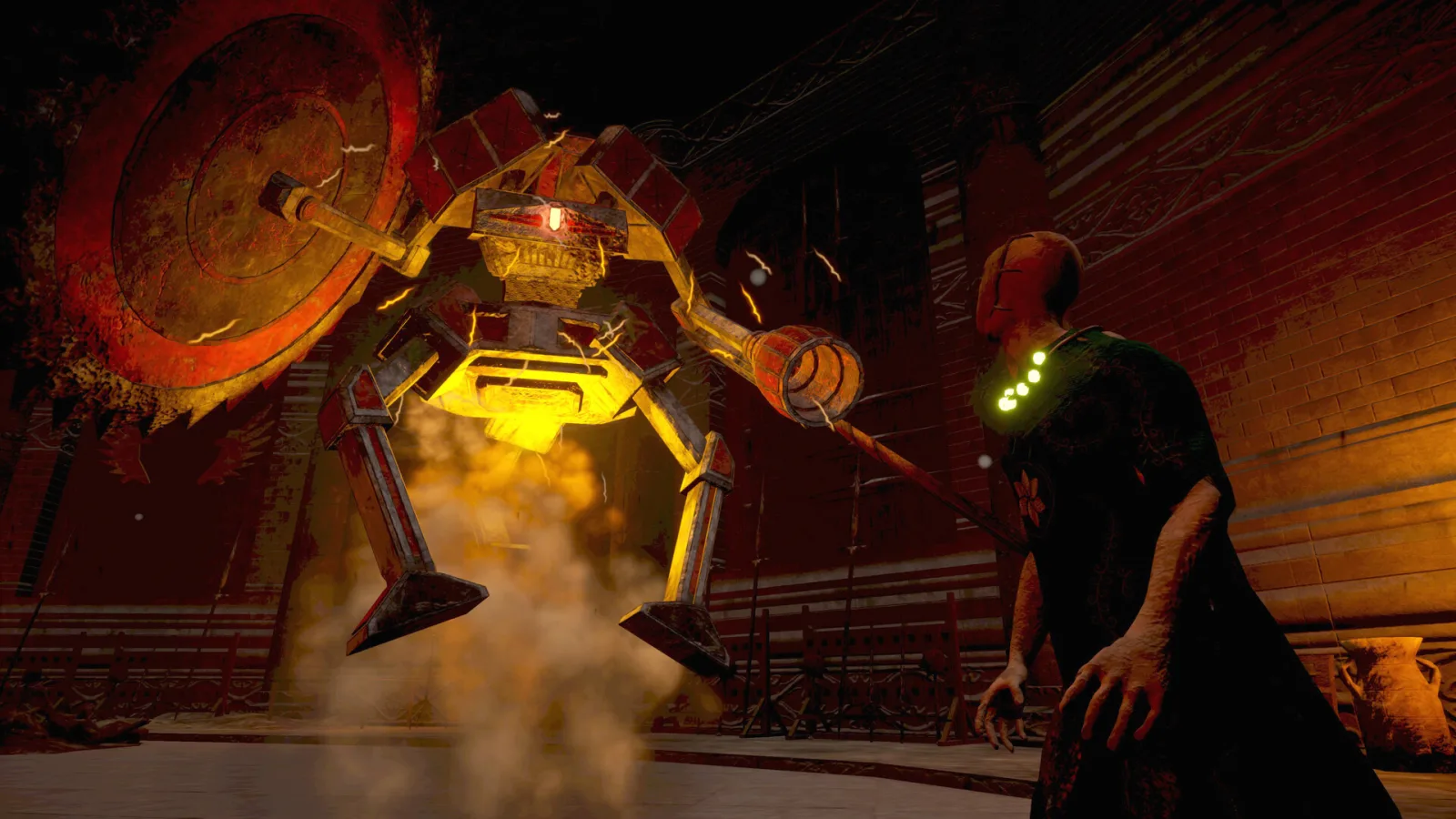
Visually, it goes for a low-fi style pulled from the fifth console generation. The commitment is total, and it pushes the retro, strange, mysterious quality the world is after. Coarse textures and angular silhouettes create an unease that clean graphics wouldn’t have produced.
Not everything lands, mind. Some movements felt slightly less precise to me, slightly less satisfying than in FromSoftware’s games, and the comparison is unavoidable when you borrow their conventions this closely. The gap shows up mostly in how much weight an attack carries. Scale matters when you judge that, though: False Hero was built solo across several years, and what it reaches on combat, worldbuilding and bosses is impressive under those conditions.

Who False Hero is for
If you want a soulslike that brings a genuinely new idea, go for it. The ability-stealing mechanic delivers across the whole run, and the atmosphere pays you back for digging into meaning yourself.
If your pleasure runs through optimising a character sheet and coming back stronger after a loss, the progression will wear you down. Anyone who loves big open maps will also find these corridors snug. Staying with independent releases, our Well Dweller review covers something shorter and far gentler. False Hero is for people who enjoy taking a combat system apart to see how it works.
My verdict on False Hero
False Hero manages what plenty of games in this genre only imitate: an original combat mechanic, carefully built bosses, an intriguing world and a mood that lasts. Its progression, locked behind scarce materials, stays a stone in the shoe and keeps the game off the rung above. Everything else makes it well worth the trip.

| What we like | What we like a lot less |
|---|---|
| Stealing enemy abilities, a combat mechanic you won’t find elsewhere | Upgrades gated behind materials that exist in limited supply |
| Combos between standard attacks and stolen abilities, which reward experimenting | Defeated enemies that stop yielding Wisdom when they respawn |
| Bosses flagged by visual, audio and environmental cues | Fights in confined spaces, where the camera shows too little |
| A dreamlike atmosphere and worldbuilding that hold across the run | Movement that lands slightly less precisely than FromSoftware’s |
| What might make you buy itA combat system built entirely on the moves you tear off your enemies | What might put you offLinear progression, where farming does nothing for you after a defeat |
Every upcoming release and update date is gathered in our calendar.